Getting started
Vision sets the destination, Linear runs the trip, /commit records each step.
New here? Start with Why Stride? first — this page assumes you've decided.
Vision — the guiding light
Before the loop, there's a question the loop can't answer: what is this project for?
/vision walks you through writing a VISION.md — seven questions, one at a time, drafted and approved before it lands at the repo root. Without it, every planner — human or AI — has to reinvent "what's this project for" from thin context. With it, the rest of stride has something concrete to measure against.
Functionally, Vision is stride's upstream anchor — planning, ranking, and implementation all read it before deciding anything. You only run /vision once per project, then evolve it sparingly. The three loop skills below are how stride executes against the Vision.
Linear integration
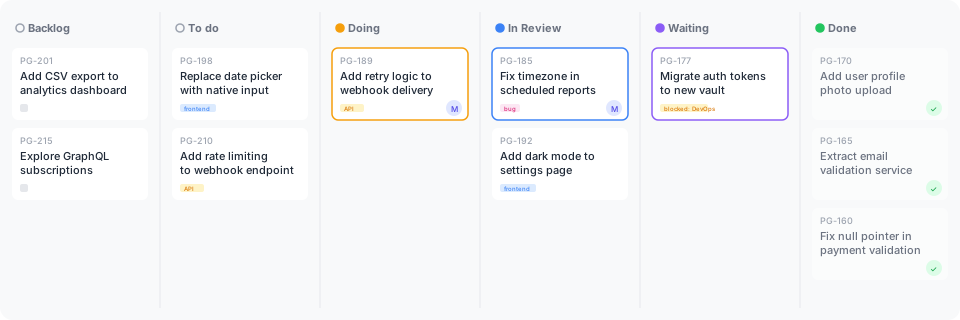 Issues flow from Backlog through Doing to Done, driven entirely by
 /linear commands.
The /linear commands connect your development workflow directly to Linear. This is an opinionated choice — Linear is keyboard-driven, git-integrated, and built for the way modern software teams actually work. No drag-and-drop boards, no workflow bloat.
Rather than context-switching between your editor and a browser, you can plan work, create issues, implement features, handle PR feedback, and close issues — all from within Claude Code. These commands cover the full development lifecycle: from researching a problem and writing a well-structured issue, through to merging an approved pull request and marking it done.
This keeps the agent grounded in real project priorities rather than working in isolation.
Stories and epics
Most issues are stories — one deliverable, ships as one PR. When several stories serve a common purpose (bigger than a PR, smaller than the Vision), /linear:plan-work groups them under a parent epic with sub-issues nested below. The umbrella moves through the kanban lanes alongside its sub-issues, so a non-engineer scanning the board sees the whole shape. See Epics and stories for the mechanism.
Atomic commits — the per-change discipline
Inside the Linear flow, every commit point calls /commit. That's where the per-change discipline lives — atomic commits that keep the git history readable, revertible, and bisectable.
Agents can produce large volumes of changes in a single session. Without discipline, those changes land as monolithic commits — impossible to review, difficult to revert, and dangerous to bisect. Atomic commits solve this by ensuring every commit contains exactly one complete logical change.
The /commit skill encodes a multi-pass methodology that separates content decisions from formatting standards. It catches the specific atomicity mistakes that AI agents make — grouping by session, by shared prefix, or by proximity rather than by purpose. Each commit becomes independently revertible, clearly explained, and safe to ship.
The loop
The three aren't independent — they're stages in the same loop, and each one makes the next one better.
/craftsharpens the problem — structured prompt generation that turns a vague idea into a clear description before the agent starts work/linearturns that description into a tracked issue, then manages the full lifecycle — branching, implementation, PR, review, merge/commitis called at every commit point within/linearto keep the git history atomic — one complete logical change per commit, independently revertible
Remove any piece and the loop still works, but the output gets worse. Without /craft, the agent works from whatever you typed. Without /commit, the agent dumps everything into monolithic commits. Without /linear, the agent works in isolation with no connection to project priorities.
"When faced with two or more alternatives that deliver roughly the same value, take the path that makes future change easier." — David Thomas & Andrew Hunt, The Pragmatic Programmer
Vibe coding produces code. Agentic engineering produces a traceable, reversible, purposeful history of decisions — every change is atomic, every change is tied to an objective, and the agent operates with the discipline of a senior engineer rather than the enthusiasm of an intern with root access.
The approach is designed to compound: as AI models improve, the structured documentation gets more from them, not less.
Next steps
- How it works — see what gets installed and how the pieces connect
- Install stride into your project
- Anchor the project with /vision
- Learn about atomic commits
- Set up the Linear workflow
- Generate better prompts with /craft